
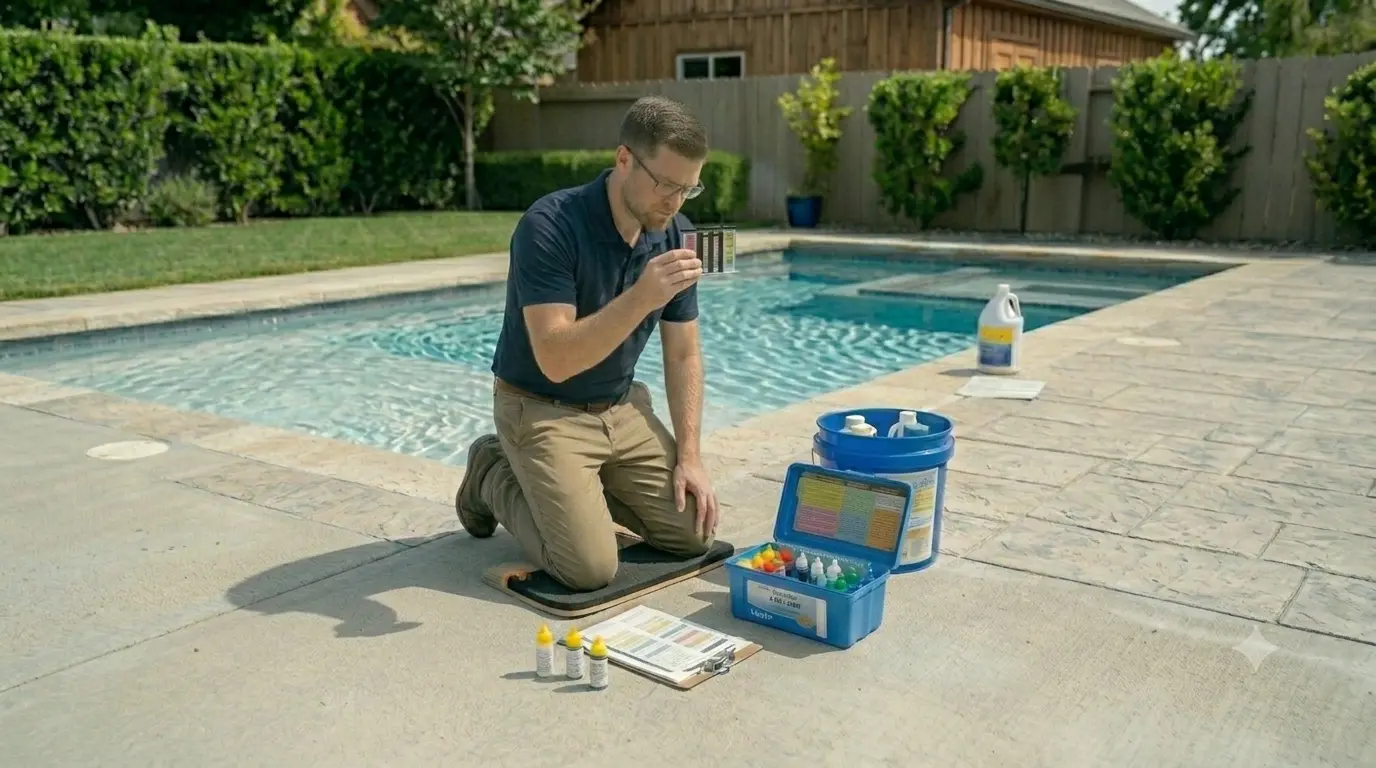
Maintaining a crystal-clear backyard pool is one of the joys of homeownership, but for many DIYers, the dream takes a hit the moment the water turns slightly cloudy. Suddenly, you find yourself staring at a wall of plastic chemical jugs, a test kit, and a massive headache.
Most DIY pool owners dread the exact same thing: the chemistry math.
Trying to figure out exactly how many ounces of muriatic acid will lower your pH by exactly 0.4—without accidentally throwing your total alkalinity out of whack—can feel like a high school algebra final. If you guess wrong, you waste money on wasted chemicals, or worse, end up with irritated eyes and itchy skin.
The good news? You don’t need a degree in chemistry to keep your water safe and clear. You just need to understand three core steps. Here is how to master pool chemical dosing without losing your mind.
Step 1: Know Your Pool’s True Volume
Before you pour a single drop of sanitizer or balancer into your water, you must know your pool’s total volume in gallons. Every single chemical dosage instruction on the back of a product bottle relies on this single number.
If you guess your volume, your chemical additions will always be a guessing game. Here are the basic geometric formulas used to find your volume:
Rectangular Pools
Round/Circular Pools
Oval Pools
💡 Quick Tip: To find your Average Depth, add the depth of the shallow end to the depth of the deep end, and divide by 2.
Step 2: Establish Your Target Baseline
Once you know your pool’s volume, you need to test your current levels and compare them to ideal pool industry standards:
| Chemical Metric | Ideal DIY Range | Why It Matters |
| Free Chlorine (FC) | 1.0 – 3.0 ppm / 3.0 – 5.0 ppm | Sanitizes the water and kills algae. |
| pH | 7.4 – 7.6 | Ensures swimmer comfort and equipment longevity. |
| Total Alkalinity (TA) | 80 – 120 ppm | Acts as a buffer to keep your pH stable. |
| Cyanuric Acid (CYA) | 30 – 50 ppm / 60 – 80 ppm | “Sunscreen” for your chlorine to prevent burn-off and evaporation. |
| Calcium Hardness (CH) | 200 – 400 ppm | Measures how “hard” or “soft” your pool water is. |
Why Free Chlorine (FC) is Different for Outdoor Pools
The standard rule of thumb for standard indoor pools is to keep Free Chlorine between 1.0 and 3.0 ppm. However, if your pool is outdoors, keeping it that low is an uphill battle.
Outdoor pools are constantly under attack from three major forces:
- The Sun: Sunlight destroys chlorine. Unprotected chlorine can be completely wiped out by UV rays in less than two hours.
- Debris: Leaves, bugs, bird droppings, and pollen constantly fall into your water. Chlorine has to work overtime to burn these contaminants away.
- Environmental Shifts: Heavy rain dilutes your chemicals, while high heat makes algae grow much faster.
Because of this, outdoor DIYers usually need to aim higher—often keeping levels around 3.0 to 5.0 ppm, depending heavily on your Cyanuric Acid level.
Why pH is the Backbone of Your Water
Your pH reading tells you how acidic or basic your water is. It acts as the control center for your pool.
- The Sweet Spot: 7.4 to 7.6.
- If it drops too low (Below 7.2): Your water becomes acidic. It will make your eyes sting, stain your pool walls, and eat away at metal equipment.
- If it climbs too high (Above 7.8): Your water becomes basic. This causes cloudy water and crusty scaling.
- The “Lazy Chlorine” Effect: High pH makes your chlorine weak. It loses its power and cannot kill bacteria or algae effectively.
Why Total Alkalinity (TA) is Your pH Shield
Total Alkalinity is different from pH. Think of alkalinity as a protective shield or buffer that keeps your pH stable.
- If it is too high: It drags your pH up with it. It locks your pH in a high position, making it very hard to lower even if you add lots of acid.
- The Sweet Spot: 80 to 120 ppm.
- If it is too low: Your pH will bounce around wildly like a rollercoaster. It might be way too high one day and completely crash the next.
Why Cyanuric Acid (CYA) is “Sunscreen” for Chlorine
Cyanuric Acid (also called stabilizer) is a lifesaver for outdoor pools. It binds to your chlorine to protect it from the sun.
- The Sweet Spot: 30 to 50 ppm (for regular chlorine pools).
- Without CYA: The sun will burn away your chlorine almost instantly. This leaves your pool wide open to an algae attack.
- If it gets too high (Above 80 ppm): It causes “chlorine lock.” The CYA holds onto the chlorine too tightly, so it cannot do its job.
- The Fix: The only way to lower high CYA is to drain some pool water and refill it with fresh water.
The Salt Pool Exception
If you have a salt water pool, your numbers look a little different.
- The Benefit: Keeping CYA higher protects your expensive salt cell from working overtime and wearing out too early.
- Salt Pool Sweet Spot: 60 to 80 ppm.
- Why it needs to be higher: A salt pool makes its own chlorine very slowly throughout the day. It needs an extra-strong shield of CYA to protect that fresh chlorine before the sun can zap it.
Step 3: The Dosage Calculation (The Hard Way)
To fix your water, you have to calculate the difference between your current test reading and your target goal. Then, you have to factor in your pool’s total volume. Doing this math yourself is where things get messy.
A Real-Life Example: Lowering Your pH
Let’s look at a common problem. Imagine you have a 15,000-gallon plaster pool. You test your water and find your pH is too high.
- Your Current pH: 8.0
- Your Target Goal: 7.4
- The Math Problem: You need to lower your pH by exactly 0.5.
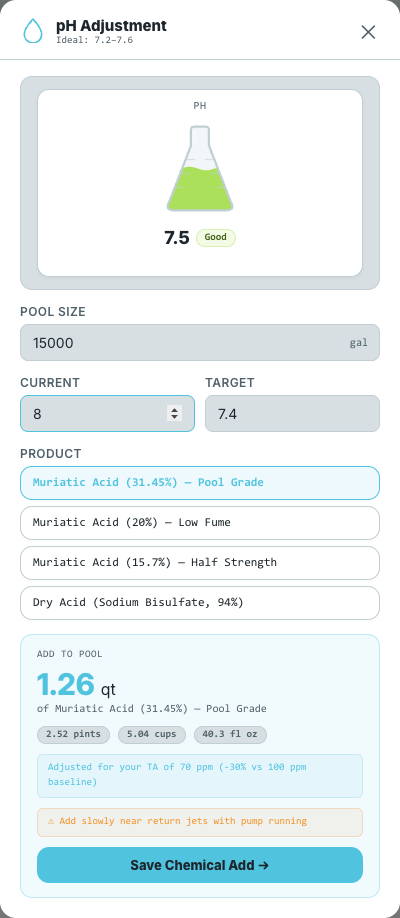
To fix this by hand, you have to dig up standard chemical dosing charts. According to those tables, lowering your pH by 0.5 in a 15,000-gallon pool requires adding 40.3 fluid ounces of 31.4% Muriatic Acid.
What if your pool is 13,500 gallons? Or 22,000 gallons? If you guess wrong, you waste money on extra chemicals or risk damaging your pool.
Stop Guessing. Let FlowBeacon Do the Math.
You do not need to carry a calculator and wet paper charts out to your pool deck. FlowBeacon is built to handle all of these complicated chemical dose calculations instantly.
How It Works (Using Our pH Example)
When you type your test results into the FlowBeacon calculator, it does all the heavy lifting for you based on your unique pool volume.
- What You Input: Current pH (8.0) and Target pH (7.4).
- What FlowBeacon Tells You instantly: Add 40.3 fl oz of Muriatic Acid (31.4% / 20° Baume).
[ Your Test: pH 8.0 ] ---> [ FlowBeacon Calculator ] ---> [ Result: Add 40.3 fl oz Acid ]FlowBeacon Handles All Your Pool Chemicals
The app doesn’t just calculate pH adjustments. It does the exact same automatic math for every single major chemical reading:
- Free Chlorine: Tells you exactly how much liquid chlorine, cal-hypo, or shock to add to hit your target parts-per-million (ppm).
- Total Alkalinity: Calculates the precise amount of baking soda or acid needed to shield your pH.
- Calcium Hardness: Figures out the exact pounds of calcium chloride needed to protect your plaster walls from becoming pitted or rough.
- Cyanuric Acid: Calculates exactly how much stabilizer to add to give your chlorine the perfect amount of “sunscreen.”
It Even Remembers Your Last Test
Testing everything every single day is exhausting. FlowBeacon saves you time by remembering your last known chemical values.
If you only have time to test your Chlorine and pH today, just type those two numbers in. The app will automatically carry over your previous Alkalinity, CYA, and Calcium numbers from your last test. Your dashboard stays updated, and your chemical calculations stay completely accurate without any extra work.